Training Machine Learning model using Tree-based model
Overview
Teaching: 20 min
Exercises: 0 minQuestions
How to train a Machine Learning model using Tree-based model
Objectives
Learn to use different Tree-based algorithm for Machine Learning training
Supervised Learning training
Train model using Decision Tree
- Tree based learning algorithms are considered to be one of the best and mostly used supervised learning methods.
- Tree based methods empower predictive models with high accuracy, stability and ease of interpretation
- Non-parametric and non-linear relationships
- Types: Categorical and Continuous

Spliting algorithm
- Gini Impurity: (Categorical)
- Chi-Square index (Categorical)
- Cross-Entropy & Information gain (Categorical)
- Reduction Variance (Continuous)
More information on how to apply the spliting algorithm to split the data can be found here
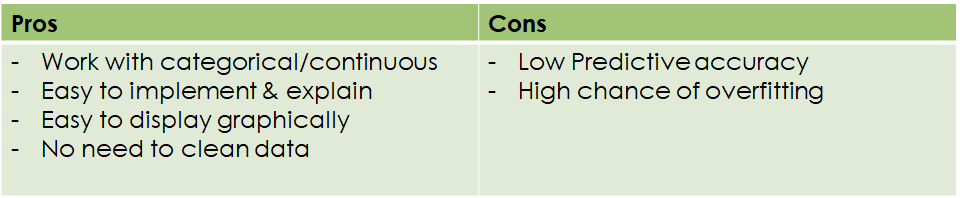
Pros & Cons
Implementation
Here we will use iris data
from sklearn.datasets import load_iris
from sklearn.model_selection import train_test_split

iris = load_iris()
X = iris.data
y = iris.target
X_train, X_test, y_train, y_test = train_test_split(X,y,train_size=0.6,random_state=123)
Next we will train using DecisionTree with gini splitting algorithm:
from sklearn.tree import DecisionTreeClassifier
model_DT = DecisionTreeClassifier(max_depth=3,criterion="gini").fit(X_train,y_train)
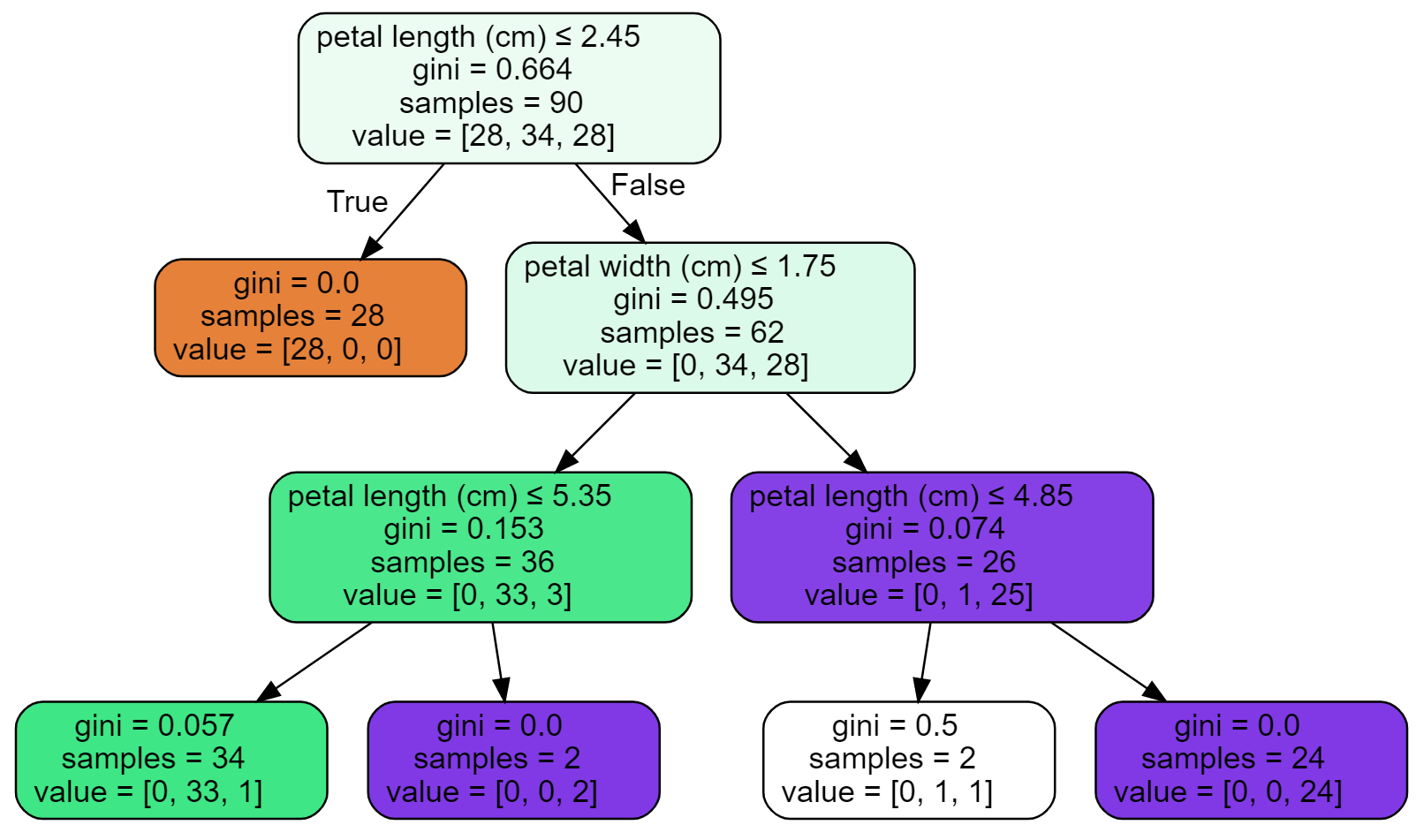
Once done, we can visualize the tree:
from sklearn import tree
tree.plot_tree(model_DT)
However, in order to have a nicer plot:
import graphviz
dot_data = tree.export_graphviz(model_DT, out_file=None,
                      filled=True, rounded=True,
                      feature_names=iris.feature_names,
                      special_characters=True)
graph = graphviz.Source(dot_data)
graph
Apply decision tree model to predic output of testing data
from sklearn import metrics
y_pred_DT = model_DT.predict(X_test)
metrics.accuracy_score(y_test,y_pred_DT)
The accuracy=0.95
More information on Decision Tree can be found here
Train model using Random Forest

- Random Forest is considered to be a panacea of all data science problems. On a funny note, when you can’t think of any algorithm (irrespective of situation), use random forest!
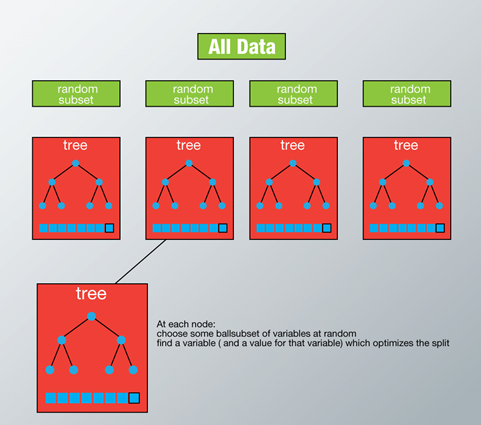
- Opposite to Decision Tree, Random Forest use bootstrapping technique to grow multiple tree
- Random Forest is a versatile machine learning method capable of performing both regression and classification tasks.
- It is a type of ensemble learning method, where a group of weak models combine to form a powerful model.
- The end output of the model is like a black box and hence should be used judiciously.
Detail explaination
- If there are M input variables, a number m<M is specified such that at each node, m variables are selected at random out of the M. The best split on these m is used to split the node. The value of m is held constant while we grow the forest.
- Each tree is grown to the largest extent possible and there is no pruning.
- Predict new data by aggregating the predictions of the ntree trees (i.e., majority votes for classification, average for regression).
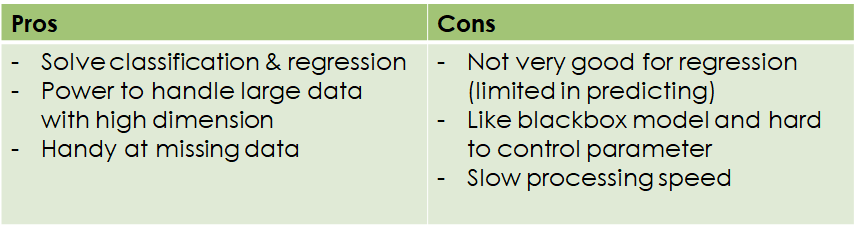
Pros & Cons of Random Forest
Implementation of Random Forest
from sklearn.ensemble import RandomForestClassifier
model_RF = RandomForestClassifier(n_estimators=20,criterion="gini").fit(X_train,y_train)
y_pred_RF = model_RF.predict(X_test)
metrics.accuracy_score(y_test,y_pred_RF)
The accuracy=0.97
In this example, we use n_estimators=20 to grow n number of trees in the forest.
We can see that Random Forest result has better prediction than Decision Tree.
More information on Random Forest can be found here
Key Points
Decision Tree, Random Forest