Training Machine Learning model using Ensemble approach
Overview
Teaching: 20 min
Exercises: 0 minQuestions
How to overcome limitation of single ML model?
Objectives
Learn to use different Ensemble ML algorithm for Machine Learning training
7.1 Why Ensemble:
Ensemble is a method in Machine Learning that combine decision from several ML models to obtain optimum output. This espisode get information from here

Ensemble approaches can reduce variance & Avoid Overfitting by combining results of multiple classifiers on different sub-samples
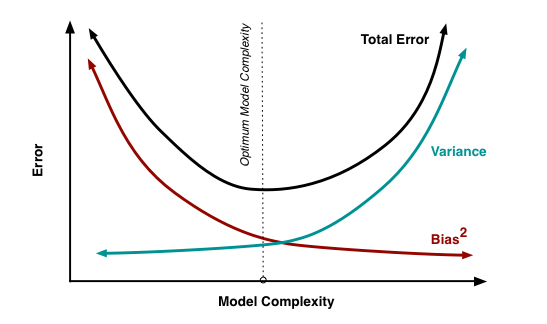
Figure. Bias & Variance Tradeoff
- Bias: the difference between the model prediction & observation. High bias: model did not train well.
- Variance: the variability of model prediction from one point to another. High variance: model performs really well in training but having high error rate in testing set
7.2 Train model using Ensemble Approach
Ensemble methods use multiple learning algorithms to obtain better predictive performance than could be obtained from any of the constituent learning algorithms alone. Unlike a statistical ensemble in statistical mechanics, which is usually infinite, a machine learning ensemble consists of only a concrete finite set of alternative models, but typically allows for much more flexible structure to exist among those alternatives. Here we will be learning several ensemble models:
- Random Forest
- Bagging
- Boosting

7.3 Train model using Bagging (Bootstrap Aggregation)
- The bootstrap method is a resampling technique used to estimate statistics on a population by sampling a dataset with replacement.
- Bootstrap randomly create a small subsets of data from entire dataset
- The subset data has similar characteristic as the entire dataset.
7.3.1 Detail explaination of Bagging
There are 3 steps in Bagging
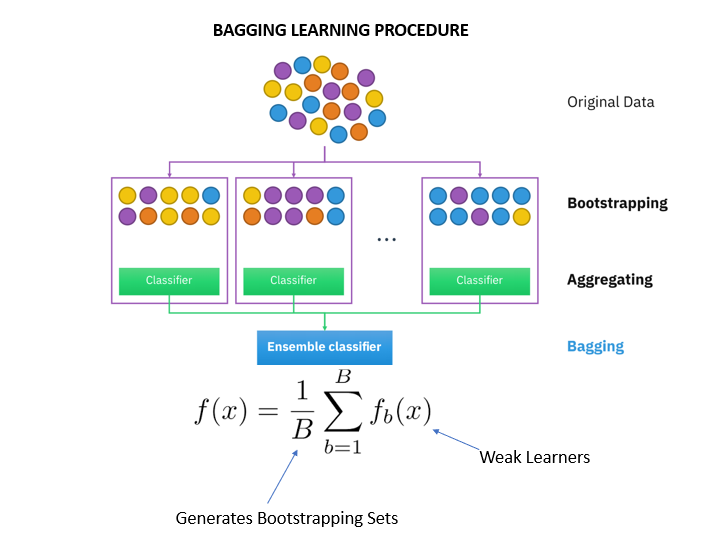
Step 1: Here you replace the original data with new sub-sample data using bootstrapping.
Step 2: Train each sub-sample data using ML algorithm
Step 3: Lastly, you use an average value to combine the predictions of all the classifiers, depending on the problem. Generally, these combined values are more robust than a single model.
7.3.2 Implementation of Bagging
Here we use iris data set:
from sklearn.datasets import load_iris
from sklearn.model_selection import train_test_split

iris = load_iris()
X = iris.data
y = iris.target
X_train, X_test, y_train, y_test = train_test_split(X,y,train_size=0.6, random_state = 123)
First apply Bagging with DecisionTree model, Bagging’s parameter can be found here:
from sklearn.tree import DecisionTreeClassifier
from sklearn.ensemble import BaggingClassifier
model_DT = DecisionTreeClassifier()

model_bag_DT = BaggingClassifier(base_estimator=model_DT, n_estimators=100,
                            bootstrap=True, n_jobs=-1,
                            random_state=123)
model_bag_DT.fit(X_train, y_train)

model_bag_DT.score(X_train,y_train),model_bag_DT.score(X_test,y_test)
The output accuracy from Bagging with DecisionTree for train/testing have : (1.0, 0.9666666666666667)
7.4 Train model using Boosting
http://uc-r.github.io/public/images/analytics/gbm/boosted_stumps.gif
- Boosting is an approach to convert weak predictors to get stronger predictors.
- Boosting follows a sequential order: output of base learner will be input to another
- If a base classifier is misclassifier (red box), its weight is increased and the next base learner will classify more correctly.
- Finally combine the classifier to predict result
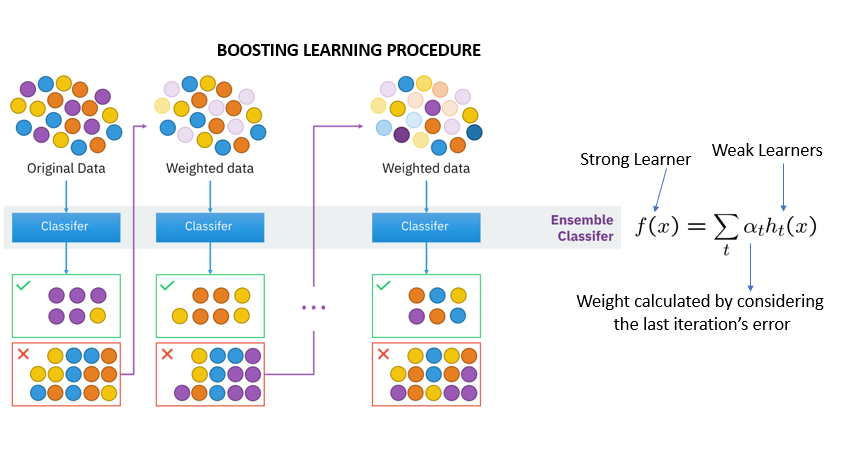
More information on Boosting can be found here
7.4.1 Adaptive Boosting: Adaboost
- Adaptive: weaker learners are tweaked by misclassify from previous classifier
- AdaBoost is best used to boost the performance of decision trees on binary classification problems.
- Better for classification rather than regression.
- Sensitive to noise
Implementation of Adaboost
from sklearn.ensemble import AdaBoostClassifier
model_AD = AdaBoostClassifier(n_estimators=100, learning_rate=0.03).fit(X_train, y_train)

model_AD.score(X_train,y_train),model_AD.score(X_test,y_test)
The output accuracy from AdaBoost for train/testing have : (0.9333333333333333, 0.8333333333333334)
7.4.2 Gradient Boosting Machines:
- Extremely popular ML algorithm
- Widely used in Kaggle competition
- Ensemble of shallow and weak successive tree, with each tree learning and improving on the previous
from sklearn.ensemble import GradientBoostingClassifier
model_GBM = GradientBoostingClassifier(n_estimators=100).fit(X_train,y_train)

model_GBM.score(X_train,y_train),model_GBM.score(X_test,y_test)
The output accuracy from GradientBoosting for train/testing have : (1.0, 0.9333333333333333)
7.5 Compare Bagging and Boosting technique:
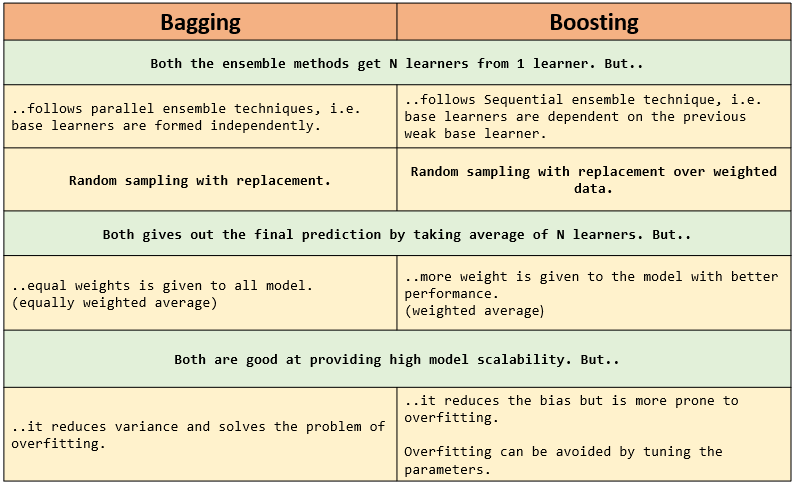
7.6 Conclusions
- Ensemble overcome the limitation of using only single model
- Between bagging and boosting, there is no better approach without trial & error.
Key Points
Bagging, Boosting